
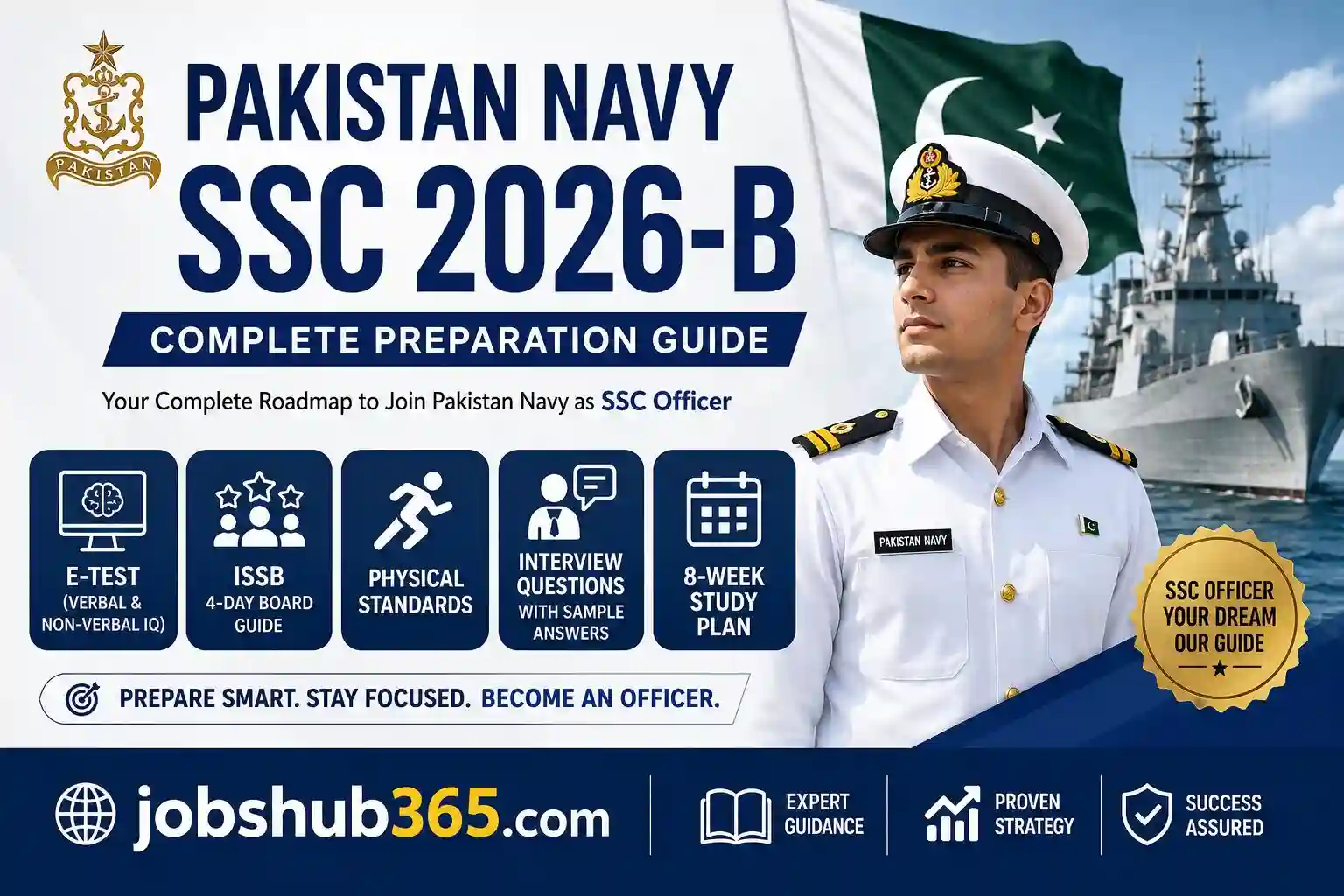
The Complete
Forces Commission
Preparation Guide
From E-Testing to ISSB to the Final Interview — every stage explained in detail, with real examples, sample questions, and a week-by-week plan to get you recommended.
Register
IQ + Academic
+ Medical
Interview
4-Day Board
Medical
Merit List
📖 In This Guide
- Understanding the Pakistan Navy SSC
- Stage 1 – Online Registration
- Stage 2 – The E-Test: Intelligence & Academic
- Stage 3 – Physical Efficiency Test & Medical
- Stage 4 – Initial Interview at PNR&SC
- Stage 5 – ISSB: The 4-Day Board
- Stage 6 & 7 – Final Medical & NHQ Merit List
- Branch-Specific Academic Preparation
- Your CV & Documents Checklist
- 8-Week Study Plan
- Officer Like Qualities (OLQs) Explained
- Golden Dos & Don’ts
⚓ Understanding the Pakistan Navy SSC
The Short Service Commission (SSC) is Pakistan Navy’s primary pathway for qualified professionals — engineers, doctors, IT graduates, lawyers, educators, and specialists — to serve as commissioned officers. Unlike the PMA Long Course which requires candidates straight from FSc, the SSC is designed for graduates and post-graduates who bring professional expertise to the Navy.
SSC officers are initially commissioned for 5 years, with strong potential for conversion to Permanent Commission (PC) based on performance, merit, and service requirements. You join as an Acting Sub-Lieutenant or Lieutenant depending on your qualifications and branch.
What’s Different About SSC
You enter with your professional degree — FCPS, BE, BS CS, LLB, MS etc. Your expertise directly shapes your role.
Initial Tenure: 5 Years
Often extended or converted to Permanent Commission based on exceptional performance and Navy requirements.
Entry Rank
Acting Sub-Lieutenant for most graduates. Direct Lieutenant entry is possible for Medical Specialists and highly experienced Engineers.
Male & Female Both
Medical, IT, Education, Special Branch, and several others are open to female candidates (M/F).
No ISSB for Medical
Medical Branch candidates attend a Personality Assessment Test (PAT) at PNR&SC instead of the full 4-day ISSB.
Benefits Package
Free medical, subsidised housing, education allowances for children, travel concessions, and international course opportunities.
📝 Stage 1 — Online Registration
Registration for SSC 2026-B is open from 10 May to 14 June 2026 at joinpaknavy.gov.pk. This is the gateway — a mistake here can disqualify you before you even sit a test.
Create Your Account
Use your active personal email address. Use your name exactly as on your CNIC — no nicknames or abbreviations.
Select Your Branch & Specialisation
Choose carefully. You can only apply to one branch per advertisement. Review all your qualifications against the requirements before committing.
Fill Academic Details Accurately
Enter CGPA, percentage, year of graduation, and institution name exactly as on your degree. Even minor discrepancies are grounds for disqualification.
Select Nearest Recruitment Centre
Choose from: Karachi, Lahore, Rawalpindi, Peshawar, Quetta, Multan, Faisalabad, Abbottabad, Hyderabad, Skardu, and others.
Download & Print Registration Slip
Print and safely store your slip. You will need it at the selection centre on test day. Multiple copies recommended.
Do NOT submit applications directly to Naval Headquarters — they will not be entertained. Only online registration via joinpaknavy.gov.pk is accepted. Candidates who have appeared in ISSB within the previous 120 days are ineligible unless a waiver is granted.
💻 Stage 2 — The E-Test: Intelligence & Academic
This is the first major elimination round. The E-Test is conducted on computer at your nearest PNR&SC (Pakistan Navy Recruitment & Selection Centre). It is sequential — you must pass the Intelligence section before the Academic section unlocks. Fail the IQ test and you leave the hall immediately.
Total Duration: 60–90 minutes (MCQ, computer-based)
Section 1 (Mandatory): Verbal + Non-Verbal Intelligence — must pass to proceed
Section 2 (Unlocks if you pass): Academic subjects relevant to your branch
Marking: No negative marking — attempt every question
Passing: ~50% in each section individually
Result: Displayed on screen immediately after completion
Part A — Verbal Intelligence Test
The Verbal IQ test measures how quickly you process language, identify relationships, and apply logic through words. There are roughly 105 mixed verbal questions in 30 minutes. Speed and accuracy both matter.
Analogies
Tests word relationships. Given A:B, find C:D with the same relationship.
Number Series
Identify the pattern and find the next number: 2, 5, 10, 17, 26, __
Odd One Out
Find the word that doesn’t belong in a group of 4–5 words.
Synonyms & Antonyms
Vocabulary-based: identify words with the same or opposite meaning.
Sentence Completion
Fill in the blank with the most appropriate word from options given.
Coding & Decoding
If ARMY = BSNZ, what is NAVY? Apply the same shift pattern.
📝 Sample Verbal Questions with Answers
Pattern: multiply by 2 each time
Part B — Non-Verbal Intelligence Test
The Non-Verbal test uses shapes, patterns and figures instead of words. It measures your spatial reasoning, pattern recognition and abstract thinking. Expect roughly 70 picture-based questions in 30 minutes. This section often trips up candidates who are strong in language but weak in visual-spatial reasoning.
Pattern Completion
A 3×3 matrix with one piece missing. Identify which option completes the pattern.
Series of Shapes
A sequence of shapes that rotate, grow or transform. Identify what comes next.
Mirror Images
Given a shape, identify its correct reflection from 4 options.
Fold & Cut
A paper is folded and cut. Identify what it looks like unfolded.
Embedded Figures
Find a simple shape hidden inside a complex larger figure.
Cube Counting
A 3D arrangement of cubes. How many are hidden or visible from a particular angle?
Practice under strict time conditions — 70 non-verbal questions in 30 minutes means under 26 seconds per question. Train with a timer from week one. Speed builds naturally with repetition, not cramming theory.
Part C — Academic Test (Branch-Specific)
This section only opens if you pass the Intelligence section. Questions are based on your declared branch and your degree subject. The academic test is at intermediate to graduation level for most branches.
| Branch | Academic Subjects Tested | Level |
|---|---|---|
| Operations (Marine/Aviation) | Physics, Maths, English, General Knowledge | FSc–Graduation |
| Mechanical Engineering | Engineering Maths, Thermodynamics, Mechanics | BE Level |
| Weapon Engineering | Electronics, Control Systems, Maths | BE Level |
| IT / Computer Science | Programming, Algorithms, Networking, Databases | BS Level |
| Medical Branch | Subject-specific MCQs (e.g. Cardiology, Surgery MCQs) | MBBS/FCPS |
| Education | English/Math/Science pedagogy + subject MCQs | MS/MPhil |
| Naval Law | Constitutional Law, Criminal Law, Contract Law | LLB/LLM |
| Special (Psychology) | Psychology MCQs (70–80 questions) | BS/MS |
📝 Sample Academic Questions
η = 1 − T₂/T₁ = 1 − 300/600 = 0.50
🏃 Stage 3 — Physical Efficiency Test & Medical
After clearing the E-Test, you proceed to a Physical Efficiency Test (PET) and a preliminary medical examination at the same selection centre. Physical failure at this stage is common — many well-prepared candidates are caught off-guard by the running requirement.
| Exercise | Male Requirement | Female Requirement | Tip |
|---|---|---|---|
| 1.6 km Run | Under 8 minutes | Under 14 minutes | Train on a measured track, not a treadmill |
| Push-ups | 10–15 reps (2 min) | Modified 8–10 reps | Full extension required — half-reps don’t count |
| Sit-ups | 15–20 reps (2 min) | 12–15 reps (2 min) | Hands behind head, full crunch |
| Chin-ups | 2–4 reps | Not usually required | Dead hang start, chin over bar to complete |
Preliminary Medical Check
Height Requirement
Minimum 5 ft 4 in (163 cm) for males. Minimum 5 ft (152 cm) for females. This is non-negotiable.
Eyesight
Operations Branch: 6/6 without glasses. Other branches (IT, Supply, Education): correctable within ±2.5 diopters is usually accepted.
Flat Feet & Knock Knees
Checked at initial medical. Mild cases may be accepted for non-operational branches. Severe flat feet are disqualifying.
Colour Blindness
Disqualifying for Operations, Aviation, and Engineering branches. Tested with Ishihara plates.
- Get your ear wax removed by a specialist at least 2 weeks before your medical — blocked ears are a common cause of failure
- Get a full dental check and cleaning — tooth infections can fail you
- Do not take painkillers or anti-inflammatory medication in the 48 hours before medical
- Hydrate well the night before — urine tests are conducted
🏋️ 6-Week Physical Training Plan
🎤 Stage 4 — Initial Interview at PNR&SC
The initial interview is conducted by a Naval Officer at the selection centre after the E-Test and physical. It is shorter than the ISSB interview — typically 15–25 minutes. It assesses your communication, confidence, motivation, family background, and basic awareness of the Navy and your branch.
Communication clarity · Motivation to join Navy · Self-awareness · Family support and background · Knowledge of your field · Current affairs awareness · Confidence under mild pressure
Commonly Asked Questions — With Sample Answers
Formal attire is mandatory. Males: clean, pressed shalwar kameez, shirt-trouser, or light lounge suit. Females: modest formal dress code appropriate to the setting. Shoes should be clean and polished. No casual wear. Hair should be neat — military-style neat is appreciated but not mandatory at this stage.
🏅 Stage 5 — ISSB: The 4-Day Board
The Inter-Services Selection Board (ISSB) is the most comprehensive and feared stage of the commission process — and rightly so. Over 4 days at one of four centres (Kohat, Gujranwala, Malir, or Quetta), you are assessed 24 hours a day by three types of officers: Psychologists, Group Testing Officers (GTOs), and Interviewers (Deputy Presidents). The result is either Recommended or Not Recommended.
Medical Branch candidates are exempt from ISSB and instead appear for a Personality Assessment Test (PAT) at PNR&SC.
You are allowed a maximum of 2 ISSB attempts. A 3rd chance may be granted if you complete a Master’s degree in a subject required by the armed forces. A 120-day cooling period is required between attempts. Being “Screened Out” twice, or being expelled from any training academy, permanently bars you from ISSB.
The 4-Day ISSB Schedule
- Report to ISSB centre with all original documents (CNIC, degrees, certificates, call letter)
- Chest number and ID photo allotment
- Administration briefing by staff — listen carefully to rules
- Complete Bio-Data forms and Psychology questionnaires online
- Opening address by Deputy President — this is where the board officially begins observing you
- Intelligence Tests (Online): Verbal Intelligence (105 Qs / 30 min), Non-Verbal Intelligence (70 Qs / 30 min) — these scores carry into ISSB weighting
- Screening Result Announced: If screened out at intelligence stage, you leave immediately
- WAT — Word Association Test: 60–100 stimulus words shown for 1 minute each — write the first sentence that comes to mind
- Sentence Completion Test: Complete 60 incomplete sentences — reveals attitudes and personality
- SRT — Situation Reaction Test: 60 everyday situations in 30 minutes — how do you react?
- Story Writing: Write a story from a vague picture — reveals imagination, values, and narrative tendencies
- Group Discussion (GD): Free discussion on a topic — assessed for communication, logic, leadership, and listening
- Lecturette: 3-minute impromptu speech on a topic chosen from a card — assessed for confidence, organisation, delivery
- Group Planning (GP): Group solves a complex scenario problem together within a time limit
- Progressive Group Task (PGT): Outdoor physical task — the group carries an object across obstacles using limited resources
- Half Group Task (HGT): Same as PGT but with half the group — gives each candidate more individual visibility
- Deputy President Interview (may begin for some candidates)
- Individual Obstacles: 8–9 obstacles to complete independently within 2 minutes each — tests physical confidence, decisiveness, and composure
- Command Task: You lead a group through an obstacle — assessed as commander, with others as helpers
- Final Group Task (FGT): Full group, outdoor, time-pressured — last chance to demonstrate leadership and teamwork
- Psychologist Interview: In-depth one-on-one with the Psychologist based on your psych test responses
- Deputy President Interview (most candidates): 30–60 minute comprehensive panel interview
- Possible re-interviews or additional Command Tasks for borderline candidates
- Conference between Psychologists, GTOs, and Deputy Presidents to finalise results
- Individual result announcement: Recommended or Not Recommended
- Documents returned, TA/DA allowance distributed
- Departure — recommended candidates await Final Medical call from Naval HQ
WAT & SRT — What They’re Really Testing
The ISSB Interview — In-Depth
The Deputy President’s interview is the most weighted part of ISSB. It can last 30 to 60 minutes. Unlike a corporate interview, the DP may challenge, contradict or even press you — this is intentional. They want to see how you behave under stress, whether you are genuine, and whether you demonstrate Officer Like Qualities (OLQs).
🏆 Stage 6 & 7 — Final Medical & Merit List
ISSB Recommended
You receive a Recommended letter from ISSB. Await call from Naval HQ for Final Medical examination.
Detailed Medical Board
Conducted at the nearest CMH (Combined Military Hospital) or PNS SHIFA Hospital. This is more thorough than the preliminary check — blood tests, ECG, chest X-ray, complete ophthalmology, and full orthopaedic assessment.
NHQ Merit List
Naval Headquarters prepares and publishes the final merit list based on overall performance across all stages. Final selection is in order of merit within each branch’s available vacancies.
Joining Instructions
Selected candidates receive official joining instructions for 6-month Basic Military Training (BMT) at Pakistan Naval Academy (PNA), Manora, Karachi.
📚 Branch-Specific Academic Preparation
Information Technology Branch
BS CS / Software Engineering / Cyber SecurityMust Revise:
- Data Structures & Algorithms (arrays, trees, sorting)
- OSI & TCP/IP model layers and protocols
- SQL queries and database normalization
- Object-Oriented Programming concepts
- Cyber security fundamentals (encryption, firewalls)
Resources:
- CS101 & CS201 VU notes (available free online)
- Schaum’s Outline of Computer Science
- Networking by Tanenbaum (Chapter 1–5)
- Past paper MCQs from pakshaheens.com
Engineering Branches (Mechanical / Weapon)
BE Mechanical / Electrical / Electronics / MechatronicsMust Revise:
- Engineering Mathematics (differential equations, matrices)
- Thermodynamics (first & second law, Carnot cycle)
- Fluid Mechanics (Bernoulli, pipe flow)
- Control Systems basics (PID, transfer functions)
- DC/AC circuit analysis (Kirchhoff’s laws)
Resources:
- Engineering Mechanics by Meriam & Kraige
- Thermodynamics by Cengel & Boles (Chapters 1–10)
- Circuit Analysis by Hayt & Kemmerly
- Solve BE final-year MCQ papers from your own university
Medical Branch
MBBS GDMOs & FCPS SpecialistsMedical branch candidates take a specialty-specific clinical MCQ test. For GDMOs, expect pharmacology, medicine, surgery, and OB/GYN MCQs at MBBS level. For specialists, expect FCPS-style MCQs in your declared specialty. Additionally, your PAT (Personality Assessment Test) replaces ISSB — prepare for psychological and scenario-based questions as described in the interview section above.
Review FCPS Part-I and Part-II past papers for your specialty from CPSP (College of Physicians and Surgeons Pakistan). These are the closest to the Navy’s clinical MCQ format.
📄 Your CV & Documents Checklist
📦 Complete Documents Checklist
- Original CNIC + 2 attested photocopies
- Online registration slip (printed)
- Matric certificate (original + attested copies)
- FSc / Intermediate certificate (original + attested copies)
- Degree certificate or transcript (original + attested copies)
- CGPA/percentage equivalence letter from your university if required
- Experience letters (if applicable)
- PMDC registration card (Medical candidates)
- PNC Card (Nursing candidates)
- 6 recent passport-size photographs (white background, formal attire)
- Domicile certificate (attested)
- Hope certificate (if degree result not yet received)
- Character certificate from last institution attended
📅 8-Week Comprehensive Study Plan
⭐ Officer Like Qualities (OLQs) — Explained
Everything at ISSB is designed to measure your Officer Like Qualities (OLQs). Understanding what these are — and honestly assessing yourself against them — is the single most impactful preparation you can do.
Effective Intelligence
Not just IQ — the ability to apply knowledge practically in real, ambiguous situations. Shown through Group Planning and Lecturette.
Communication
Clear, confident expression in English and Urdu. Both verbal and written (story writing, group discussion).
Determination
Persistence in completing tasks despite obstacles. Seen most clearly in individual obstacles and PGT.
Group Co-operation
Working with, not against, the group. Contributing ideas, listening, and supporting others’ plans when better.
Initiative
Stepping forward when no one else does. Taking ownership without being asked. Starting Group Discussions, volunteering for command tasks.
Self-Confidence
Not arrogance — composed, grounded assurance. Disagree respectfully when you have a better idea; accept when you don’t.
Physical Fitness
Completing obstacles without hesitation. A fit body signals a disciplined mind to the assessors.
Integrity
Your WAT and SRT responses reveal this more than anything you consciously say. Be authentic — inconsistency is immediately detected.
- Lying or exaggerating in the interview or bio-data forms
- Aggressive, domineering behaviour in group tasks (talking over everyone)
- Passive non-participation — sitting silently during group discussions
- Inconsistency between what you write in psych tests and what you say in interviews
- Displaying panic, frustration or emotional volatility during tasks
✅ Golden Dos & Don’ts
Always Do
- Apply early — registration closes sharply on 14 June 2026
- Carry original documents AND attested copies to every stage
- Get ear wax cleared and teeth cleaned before medical
- Be your genuine self at ISSB — the board detects performance
- Speak up in group discussions — even if uncertain
- Read Dawn newspaper daily for current affairs from now
- Know your own CV perfectly — every line may be questioned
- Sleep well the night before every stage
- Be respectful to all ISSB staff — you are observed from arrival
- Practice timed tests daily — accuracy under pressure is a skill
Never Do
- Never lie or exaggerate — inconsistencies are cross-checked
- Don’t submit applications directly to Naval HQ
- Don’t enter ISSB within 120 days of a previous attempt
- Don’t dominate group tasks — lead, don’t bully
- Don’t be silent in group discussions — passivity is penalised
- Don’t take any medication affecting alertness before tests
- Don’t apply for the wrong branch just for higher chances
- Never show negativity about Pakistan, Army, or institutions
- Don’t discuss your interview content with other candidates at ISSB
- Don’t treat ISSB as a game — the board reads rehearsed behaviour
⏰ Registration Closes 14 June 2026
Start your preparation today. Every day of delay is a day of advantage handed to your competition.
📄 Build a Professional Military-Style CV
A polished, well-structured CV significantly strengthens your initial application. Use our free builder — no sign-up required.
🚀 Build My Free CV Now
Team Jobshub365 is a dedicated group of researchers and content editors who publish verified job updates, career guides, and exam resources for Pakistan. Our mission is to provide accurate, timely, and easy-to-understand information to help job seekers succeed.