
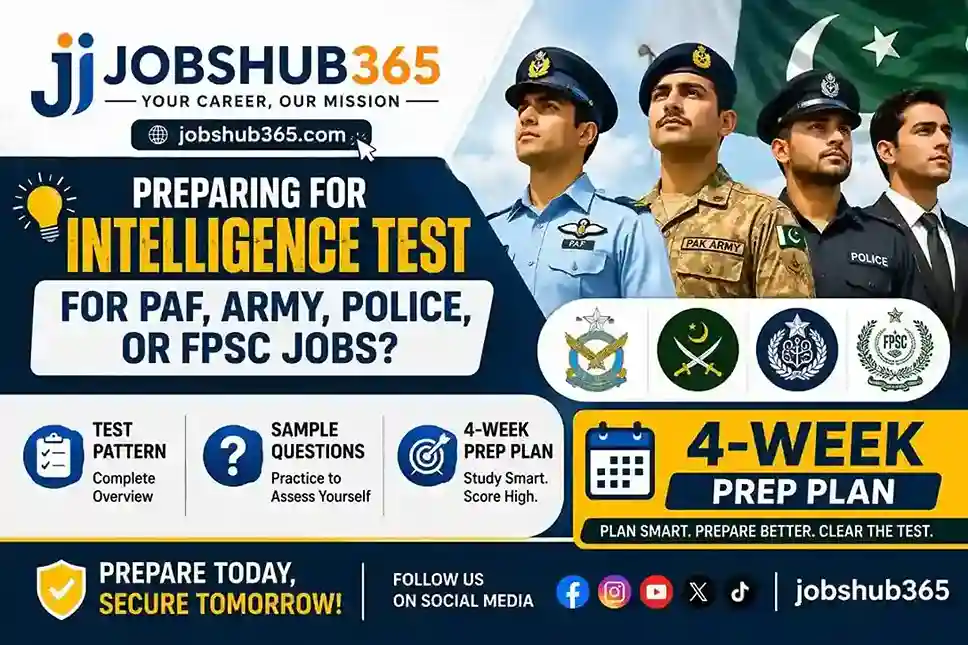
Crack Any Intelligence Test: The Complete Guide to Passing PAF, Army, Police & Government Job IQ Tests in Pakistan
One skill separates candidates who get shortlisted from those who don’t — knowing exactly how Pakistan’s intelligence and aptitude tests are designed. This guide breaks down the real pattern used by PAF, Pakistan Army, FPSC, Police, and other public-sector recruiters, so you walk into your test already one step ahead.
Start Your Prep Plan Now →Why Every Government Job in Pakistan Now Includes an Intelligence Test
Whether you are applying to the Pakistan Air Force (PAF), Pakistan Army, Navy, Police Department, FPSC, PPSC, NADRA, or almost any uniformed or civil department, your application rarely gets decided at the interview alone. Long before that, recruiters use a short, timed intelligence or aptitude test to filter thousands of applicants down to a manageable shortlist. This single stage often eliminates more candidates than the physical test and interview combined.
The good news: these tests are highly predictable. They are not designed to confuse you — they are designed to measure logical thinking, numerical speed, verbal reasoning, and basic general awareness under time pressure. Once you understand the pattern, scoring well becomes a matter of practice, not luck.
What Exactly Is a Departmental Intelligence Test?
An intelligence test (sometimes called an IQ test, aptitude test, or psychological screening test depending on the department) is a short objective-type paper used to assess a candidate’s reasoning ability rather than subject-specific knowledge. It typically includes:
- Verbal reasoning — analogies, sentence completion, vocabulary, synonyms/antonyms
- Numerical reasoning — basic arithmetic, number series, ratios, percentages
- Non-verbal/logical reasoning — pattern recognition, odd-one-out, figure series
- General knowledge — current affairs, Pakistan studies, Islamic studies (department-dependent)
- Spatial & abstract reasoning — especially common in PAF technical and GD(P) Pilot streams
Departments in Pakistan That Use Intelligence Tests for Hiring
| Department | Test Focus | Typical Stage |
|---|---|---|
| Pakistan Air Force (PAF) | Verbal, numerical, spatial reasoning, general science | Initial Tests (ISSB-linked for officer cadre) |
| Pakistan Army | Verbal, numerical, abstract reasoning | Pre-ISSB screening |
| Pakistan Navy | Numerical, verbal, technical aptitude | Initial Test |
| FPSC (Federal) | General knowledge, verbal, analytical | Written/MCQ stage |
| Punjab/Provincial Police | Verbal, numerical, GK, current affairs | Written test before physical |
| NADRA / Banks (NBP etc.) | Numerical, verbal, analytical reasoning | Online/written screening |
Browse live opportunities across these and other sectors on our government jobs section, or explore openings in the private sector via private jobs.
The Common Pattern Behind Almost Every Pakistani Recruitment IQ Test
Despite different department names, the underlying structure repeats itself:
- Time limit: Usually 30–60 minutes for 50–100 MCQs.
- Negative marking: Common in FPSC and police tests — guessing carelessly can cost you.
- Sectioned format: Verbal, numerical, and logical sections are usually separated.
- Speed over depth: Questions are individually easy but designed to be answered fast — the real test is your pace.
A Realistic 4-Week Preparation Strategy
Week 1 — Diagnose: Attempt one full past paper untimed to identify your weakest section.
Week 2 — Build Speed: Drill number series, analogies, and synonym/antonym sets daily for 30 minutes.
Week 3 — Simulate: Take timed mock tests replicating the real exam duration and negative marking.
Week 4 — Polish: Focus only on your weak areas and revise current affairs/general knowledge.
While you prepare, keep your documents ready. Check your eligibility instantly with our free Age Calculator, and once you’re shortlisted, build an ATS-friendly resume in minutes using our cv builder — built specifically for Pakistani government and private job applications.
Sample Intelligence Test Questions (With Logic Explained)
Q1. Find the odd one out: Aeroplane, Helicopter, Glider, Submarine
Answer: Submarine — the other three operate in air; this one operates underwater.
Q2. Number series: 3, 6, 12, 24, ?
Answer: 48 — each number doubles the previous one.
Q3. Analogy: Pilot is to Aircraft as Captain is to ____?
Answer: Ship — both denote the person commanding the respective vehicle.
Common Mistakes That Cost Candidates Their Shortlist
- Spending too long on one difficult question instead of moving on
- Ignoring negative marking rules and guessing blindly
- Skipping general knowledge revision, assuming only “logic” matters
- Not practicing under actual time pressure before the real test
- Applying without first checking eligibility — always confirm with the Age Calculator before test day
Pro Tips From Past Candidates
✅ Attempt the section you’re strongest in first to build momentum.
✅ Carry a clear CNIC, recent photographs, and printed documents — incomplete paperwork disqualifies otherwise-qualified candidates.
✅ Sleep well the night before; speed-based reasoning tests are heavily affected by fatigue.
✅ Keep your CV and academic documents updated in advance using our CV Builder so you’re ready the moment a shortlist call comes.
Frequently Asked Questions
Is the PAF intelligence test the same as the IQ test for Pakistan Army?
They are similar in structure (verbal, numerical, logical reasoning) but PAF papers often include additional spatial and general science components relevant to aviation and technical trades.
Can I pass without coaching academies?
Yes. Most of these tests rely on consistent self-practice with past papers and timed mock tests rather than expensive coaching.
Is there negative marking in every department’s test?
Not always — FPSC and several police tests apply negative marking, while some PAF/Army initial tests do not. Always confirm from the official test instructions on test day.
How can I find the latest job openings to apply for after preparing?
You can browse fresh listings daily on our Government Jobs and Private Jobs pages.
Ready to Take the Next Step?
Preparation gets you through the test — but you still need the right opportunity. Explore today’s verified listings on Government Jobs and Private Jobs, check your eligibility with the Age Calculator, and get your application-ready CV in minutes with our CV Builder.